
Industries · Manufacturing & Warehouses
Fire Protection for Manufacturing & Warehouses
The Catawba Valley has been a manufacturing region for well over a century — furniture, textiles, fiber optics, food production, and the supply chain around all of it. Those buildings carry fire protection requirements that scale with floor area, ceiling height, what is stored, and what the process actually does.
We handle extinguisher coverage, emergency and exit lighting, industrial suppression systems, and pre-inspection walkthroughs for manufacturing and warehouse facilities across the region.
Coverage is driven by three things
- Hazard classification — what you store and process determines the rating of extinguisher required.
- Travel distance — how far a person walks from anywhere on the floor to reach a unit.
- Layout — racking, equipment, and partitions change the actual path, not just the straight line.
Process hazards and industrial suppression
Some operations carry hazards that portable extinguishers alone do not address — finishing and spray booths, dust collection on woodworking equipment, and specific process machinery. These are protected by pre-engineered suppression systems designed for that hazard, distinct from a kitchen system.
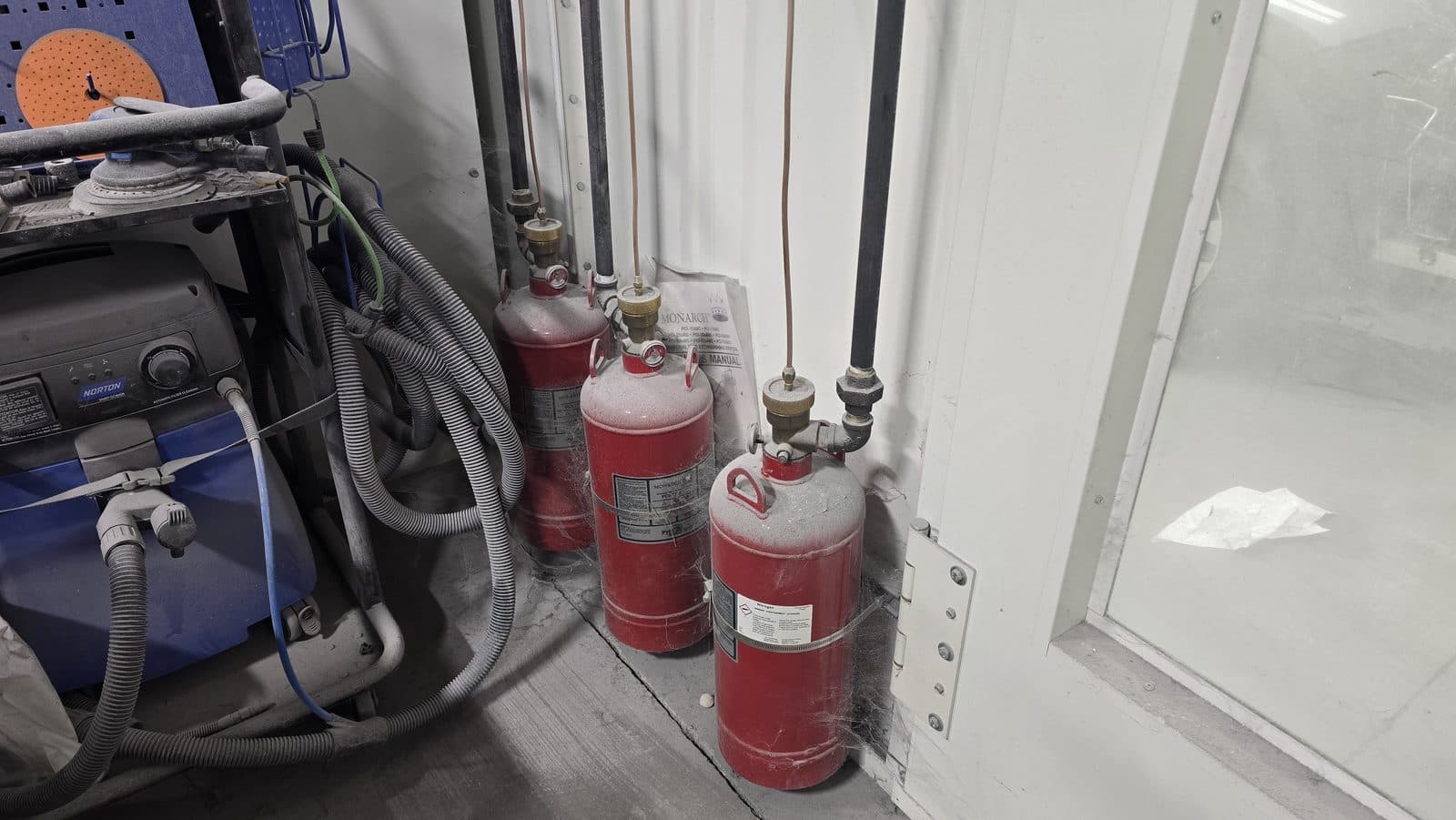
If you have a system like this, it carries its own inspection cycle and its own documentation. Tell us what you have and we will tell you honestly whether it is within our scope or needs a specialist.
The clearance findings
Two clearance requirements account for a large share of warehouse violations, and both are free to comply with.
- Storage kept clear below sprinkler deflectors — commonly eighteen inches. Stacking into that space breaks the spray pattern the system depends on.
- Clear working space in front of electrical panels — commonly about three feet, kept clear at all times, not "we can move that."
Paint the floor in front of panels and mark the maximum rack line. It removes the judgment call for seasonal staff, which is where most of these violations come from.
Hot work, and the fire that starts two hours later
Welding, cutting, and grinding are routine in most manufacturing buildings, which is exactly why they get treated casually. Sparks travel further than people expect, land in material nobody was watching, and smoulder.
A great many industrial fires start well after the last spark, in a pile of packaging or a dust accumulation that was quietly heating the whole time. A fire watch after hot work stops is not bureaucracy — it is the interval when the fire actually starts.
- Clear combustible material from the area before work starts, not after
- Keep an extinguisher rated for the surrounding hazard within reach
- Watch the area after the work stops rather than walking away
- Take particular care near dust collection, packaging storage, and anywhere fine material accumulates
When the floor gets reconfigured
Manufacturing floors change constantly — a line moves, racking goes in, a mezzanine gets added, a wall goes up to make a parts room. Every one of those changes can quietly break something that was compliant last year.
| Change | What it can break |
|---|---|
| Racking added to open floor | Extinguisher travel distance, sprinkler clearance |
| Line relocated | Extinguisher placement relative to the hazard |
| New interior walls | Egress path length, emergency lighting coverage |
| Mezzanine added | Egress from the upper level, lighting on stairs |
| Process change or new material | Hazard classification, required extinguisher rating |
| Equipment moved off a suppression system | Nozzle coverage on a pre-engineered system |
None of these are visible problems. The building looks fine and the tags are current. It is worth a walkthrough after any significant reconfiguration rather than finding out at the next inspection.
Emergency lighting in large buildings
A manufacturing floor with no windows goes completely dark in a power failure. Emergency lighting has to illuminate the actual egress path — down the aisle, around the equipment, through the door, and to the exterior.
Gaps we find regularly: stairs and mezzanines with no coverage, heads aimed at equipment instead of the aisle, additions where lighting was never extended, and fixtures removed during a line reconfiguration and never reinstalled.
Common questions
How many extinguishers does a warehouse need?
It depends on floor area, hazard classification, and the layout that determines travel distance. Two buildings of identical square footage can need very different counts. A walkthrough gives you a real number.
We added racking. Does that change anything?
It can change two things at once — travel distance to the nearest extinguisher, and storage clearance below sprinkler heads. Both are worth checking after any significant floor reconfiguration.
Do you service spray booth suppression systems?
Tell us what you have and we will give you a straight answer on whether it is within our scope. We would rather refer you than tag something we should not.