
NFPA 10
Fire Extinguisher Inspection & Service
A fire extinguisher is the only piece of fire protection equipment in most buildings that a person actually picks up and uses. Everything else — sprinklers, alarms, emergency lighting — works whether anyone is paying attention or not. An extinguisher only works if it was maintained, if it is where it is supposed to be, and if someone can reach it in the few seconds they have.
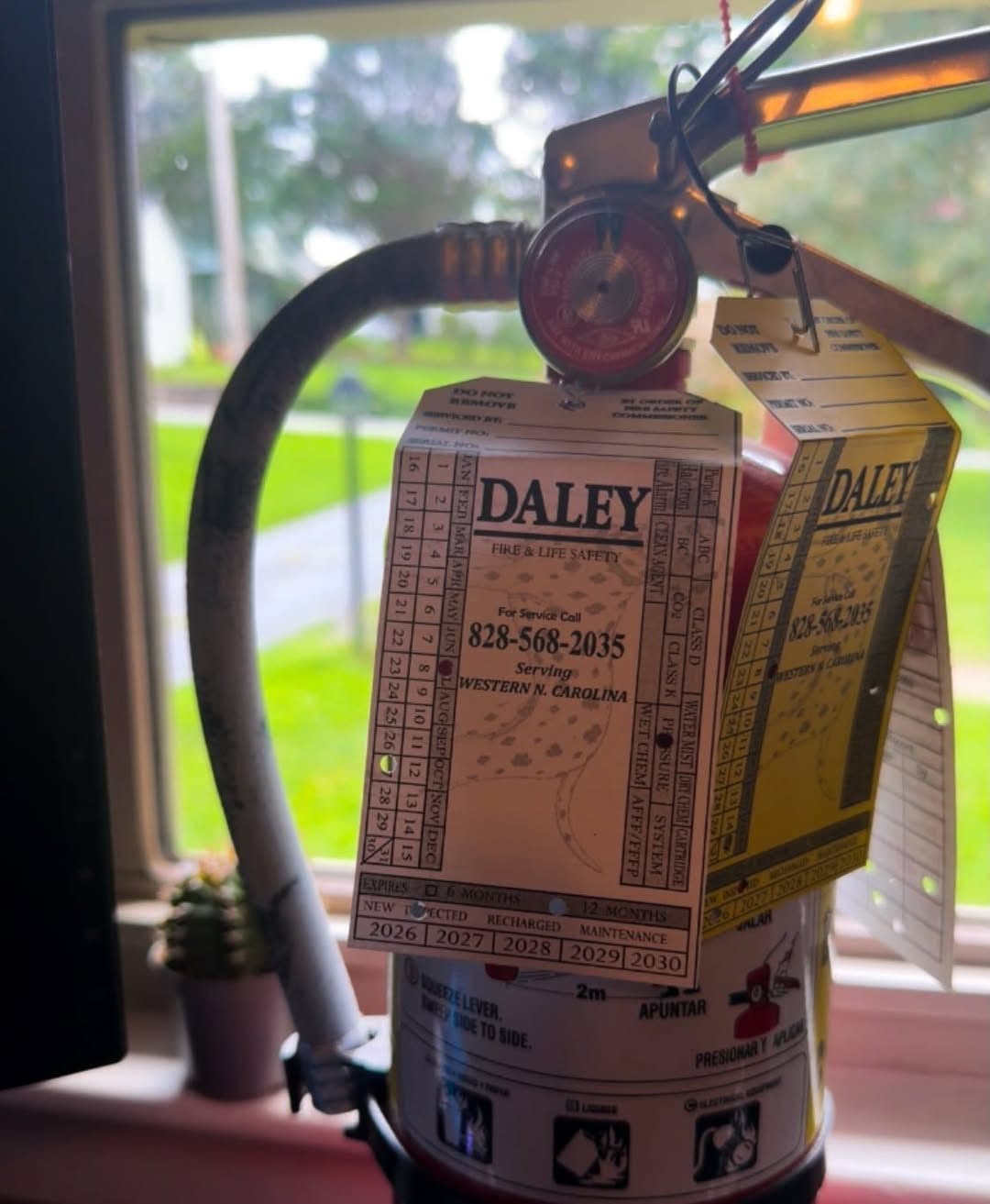
That is why the tag matters. The tag is the record that a trained person put hands on the unit, verified it, and certified it. When a fire marshal walks your building, the tag is often the first thing checked, and an expired one is among the most common violations written in commercial buildings.
We inspect, service, recharge, replace, and install portable fire extinguishers for commercial buildings across Western North Carolina. Below is what that actually involves.
What annual inspection and maintenance covers
NFPA 10 draws a distinction that trips up a lot of business owners. A monthly "inspection" is a quick visual check that you or your staff perform. Annual "maintenance" is a thorough examination performed by a trained person — that is the one that produces a new tag.
During annual maintenance on a typical stored-pressure extinguisher, we work through the unit systematically:
- Pressure gauge reading within the operable range
- Pull pin present, and the tamper seal intact and unbroken
- Hose and nozzle clear, uncracked, and free of obstruction
- Shell, neck, and base checked for corrosion, dents, or damage
- Weight verified against the unit's stated charge
- Operating instructions legible and facing outward
- Manufacturer label and service history readable
- Bracket or cabinet secure, and the unit mounted at compliant height
- Location matches the hazard it is there to protect
- Clear access — nothing stacked, parked, or stored in front of it
Internal examination and hydrostatic testing
Beyond the annual service, extinguishers require deeper work at longer intervals. These are the ones businesses tend to be caught out by, because they arrive years apart and nobody is tracking them.
Internal examination means the unit is emptied, opened, and inspected from the inside — the shell interior, the valve, the siphon tube — then recharged and returned to service. Hydrostatic testing pressure-tests the cylinder itself to confirm it can still safely hold its charge.
| Service | Typical interval |
|---|---|
| Visual inspection by owner or staff | Monthly |
| Maintenance by a trained technician | Annually |
| Internal examination | Varies by extinguisher type and agent |
| Hydrostatic testing | Varies by extinguisher type and agent |
Intervals for internal examination and hydrostatic testing depend on the agent and cylinder type — a stored-pressure dry chemical unit, a CO2 unit, and a wet chemical unit are all on different schedules. We identify what each of your units needs and tell you when it comes due, rather than leaving you to work it out from the label.
There is a point at which testing an old extinguisher costs more than replacing it. When that is the case we will say so instead of quietly billing for the service.
Recharge, and when replacement is the better call
An extinguisher must be recharged after any discharge — including a partial one. There is no such thing as a unit that was "only used a little." Once the seal is broken and pressure has escaped, it cannot be relied on again until it is recharged and re-certified.
We recharge after:
- Any use, including a brief test or an accidental discharge
- A failed annual inspection where the unit is otherwise sound
- Internal examination, as part of returning the unit to service
- Pressure loss found during a monthly or annual check
Replacement usually makes more sense when the shell shows corrosion or damage, when the unit is approaching a hydrostatic test that costs close to a new extinguisher, when the extinguisher is the wrong class for the hazard it now sits next to, or when parts are no longer available for an older model.
Choosing the right extinguisher for the hazard
Extinguisher classes describe what kind of fire the agent is rated to put out. Putting the wrong class next to a hazard is worse than useless — it can make the fire worse and injure whoever picked it up.
| Class | What it is rated for |
|---|---|
| A | Ordinary combustibles — wood, paper, cloth, most plastics |
| B | Flammable liquids and gases — fuels, solvents, oils, paints |
| C | Energized electrical equipment |
| D | Combustible metals, typically in specific industrial processes |
| K | Cooking oils and fats in commercial kitchens |
Most commercial spaces are covered by multipurpose ABC dry chemical units. The exceptions matter, though. A commercial kitchen needs Class K near the cook line, because dry chemical on a grease fire can splash burning oil. Server rooms and electrical spaces often call for CO2 or a clean agent, because dry chemical residue destroys the equipment it lands on. Auto shops, paint booths, and anywhere solvents are handled need genuine Class B capacity, not just an ABC unit hung by the door.
If you are not sure what your building needs, that is what a walkthrough is for. We would rather size it correctly the first time.
Placement, mounting, and travel distance
An extinguisher that is present but badly placed still fails an inspection. NFPA 10 sets maximum travel distances — how far a person should have to walk to reach one — and those distances tighten as the hazard gets more severe. Class K units in kitchens carry a notably shorter travel distance than general Class A coverage.
Placement problems we correct regularly:
- Units mounted too high or resting directly on the floor
- Travel distance exceeded across large open warehouse floors
- Extinguishers blocked by seasonal stock, pallets, or equipment
- No signage where the unit is not visible from the approach
- Units removed during a remodel and never remounted
- Kitchen units mounted where you would have to cross the fire to reach them
We supply and install brackets, wall hangers, and recessed or surface-mount cabinets, and we will tell you where units should go rather than simply rehanging them where the last company left them.
What happens after we service your equipment
Every unit that passes leaves with a current tag showing the service date and who performed it. You get documentation of what was inspected, what was corrected, and what is coming due — which is the paperwork an inspector asks for and the paperwork most businesses cannot find.
If something fails, we tell you before we leave. You will know what failed, whether it can be recharged or needs replacing, what it costs, and how urgent it is. No surprise invoice, and no discovering a problem when the fire marshal does.
What your staff can check themselves
The monthly visual check is meant to be done by you, not by a contractor. It takes about a minute per unit and it catches the majority of problems long before the annual service.
- Is it where it is supposed to be, and can you reach it without moving anything?
- Is the gauge needle in the green?
- Is the pin in place and the tamper seal unbroken?
- Is the hose clear and free of cracks?
- Any dents, rust, or damage to the shell?
- Is the tag current, and are the instructions legible?
- Initial and date the tag or your log.
Anything that fails one of those checks, call us. We would much rather come out for one unit in March than have you find six problems the week of your inspection.
Businesses we serve
Extinguisher requirements scale with how a building is used. A retail storefront and a finishing shop carry very different hazards even at the same square footage.
- Restaurants and commercial kitchens — Class K at the cook line plus ABC coverage back of house
- Warehouses and manufacturing — travel distance and hazard classification drive unit count
- Auto shops and finishing booths — genuine Class B capacity for solvents and fuels
- Churches and assembly spaces — kitchen, fellowship hall, and mechanical areas
- Medical, dental, and assisted living — documentation standards are strictest here
- Retail and shopping centers — landlord and tenant responsibility often unclear
- Offices and professional buildings — lower hazard, same inspection cadence
- Apartments, multifamily, and HOAs — common-area equipment is the owner's responsibility
Common questions
How often do commercial fire extinguishers need to be inspected?
A visual inspection by you or your staff monthly, and maintenance by a trained technician annually. Internal examination and hydrostatic testing come due at longer intervals that vary by extinguisher type. Your local authority having jurisdiction sets what applies to your specific building.
What happens if our extinguisher tag is expired?
An expired tag is one of the most commonly written violations in commercial buildings. It does not mean the extinguisher will not work, but it does mean there is no record that anyone has verified it, and an inspector has to treat it as unverified. It is usually a quick fix — most units just need annual service and a new tag.
Can I just buy extinguishers at a hardware store?
You can buy them, but commercial buildings still need them inspected, tagged, and documented by a trained person, and they need to be the right class and size for the hazard. Buying units that turn out to be undersized or the wrong class is a common and avoidable expense.
Do you service extinguishers we did not buy from you?
Yes. We service whatever is already in your building regardless of who supplied or last tagged it.
What does it cost?
It depends on how many units you have, what type they are, and what each one needs — a straightforward annual inspection is very different from a unit due for hydrostatic testing. Call us with a rough count and we can give you a realistic number before we come out.
We just failed a fire inspection. Can you help?
Yes, and it is worth calling sooner rather than later since correction periods are usually short. Send us the inspection report and we will tell you which deficiencies fall within our scope and what it takes to correct them.
Fire Extinguishers by location
Based in Claremont, serving commercial buildings within roughly 90 miles.