
NFPA 101
Emergency & Exit Lighting
Emergency lighting is the equipment nobody thinks about until the power goes out. It sits on the ceiling for years doing nothing visible, quietly running on a battery that degrades whether the unit is ever used or not.
That is exactly why it fails. The most common finding is not a broken fixture — it is a fixture that lights up when you press the test button and then dies four minutes into a ninety-minute test. In a real evacuation, four minutes of light in a smoke-filled stairwell is not enough.
We inspect, test, repair, and install emergency and exit lighting for commercial buildings across Western North Carolina.
The two tests, and why the short one is not enough
Emergency lighting carries two distinct testing requirements, and the difference between them is where most buildings quietly fall out of compliance.
| Test | Interval |
|---|---|
| Functional test — brief activation to confirm the unit illuminates | Monthly |
| Duration test — full-length discharge under battery power | Annually |
The monthly test is the one your staff can perform: press and hold the test button, confirm the lamps come on. It takes seconds per fixture and catches dead units, failed lamps, and disconnected fixtures.
The annual duration test is the one that actually proves the equipment works. The unit runs on battery for the full required duration, and it either sustains illumination for the whole period or it fails. Batteries that pass a thirty-second test routinely fail at fifteen minutes. That is the failure mode a monthly check cannot catch, and it is why the annual test is not optional.
What we check
- Full-duration discharge test on battery power
- Battery condition, age, and charge acceptance
- Lamp and LED function on both heads
- Head aim — lighting the egress path, not the ceiling or a wall
- Exit sign illumination, legibility, and correct directional arrows
- Charging circuit and indicator function
- Housing condition and secure mounting
- Coverage across the actual egress path, including stairs and turns
- Documentation and test records brought current
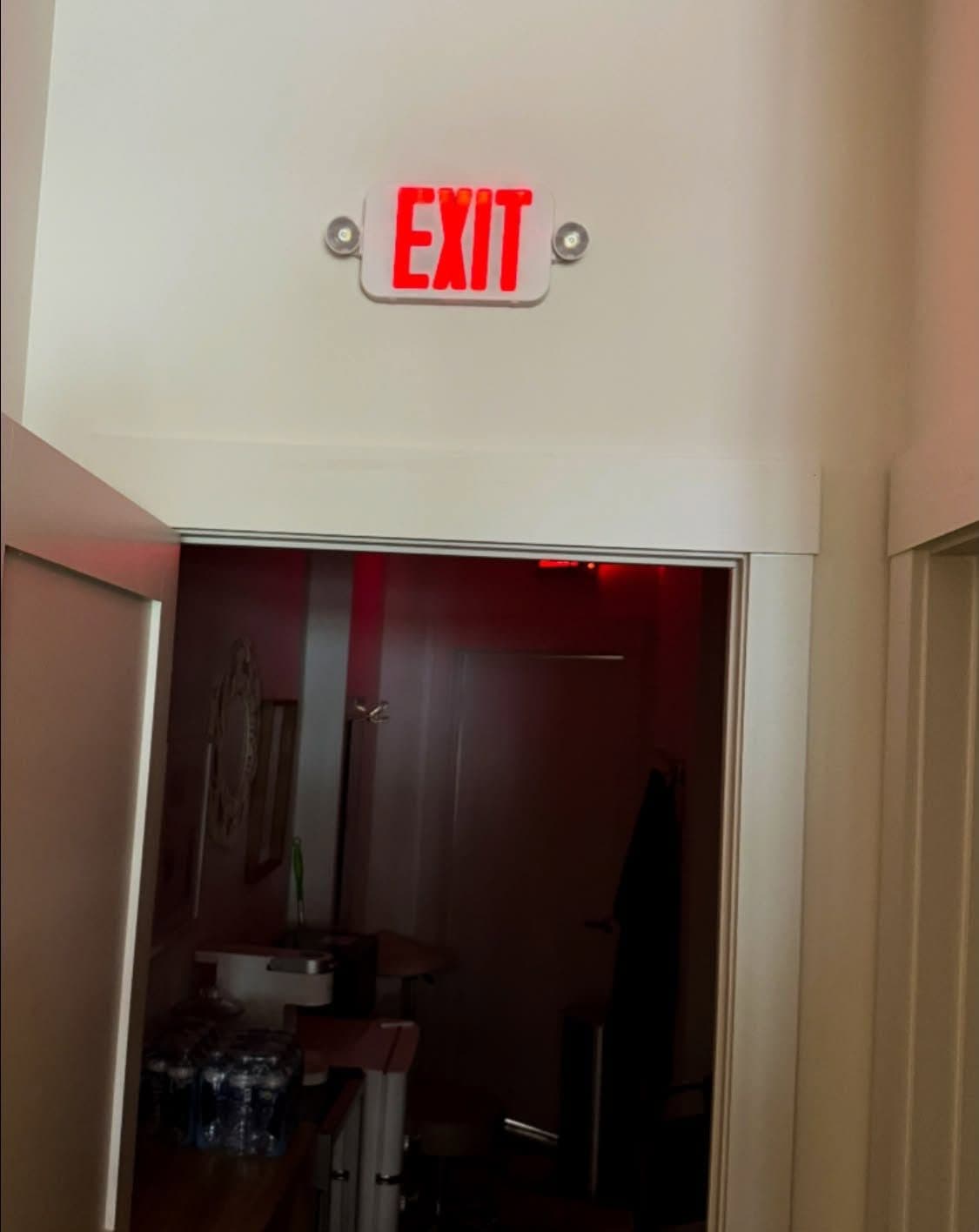
Battery and unit replacement
Emergency lighting batteries have a finite service life measured in years, and they degrade on a schedule regardless of how often the unit is used. A building that installed all its fixtures at once will tend to see them fail at roughly the same time, which is why a first inspection at an older building often turns up several failures together.
We replace batteries where the fixture is otherwise sound, and replace whole units where the housing is damaged, the charging circuit has failed, parts are no longer available, or the cost of repair approaches the cost of a new fixture. Modern LED units draw substantially less power, which means smaller batteries and longer service life, so replacement is often the better economics on an older fixture.
Coverage, placement, and new installation
Emergency lighting has to illuminate the path of egress — not the room in general. That means the corridor, the turns, the stairs, the landing, and the discharge to the exterior. Buildings frequently have fixtures that work perfectly and still leave a dark stair landing, because the units were placed for convenience of wiring rather than for the route people will actually take.
Gaps we find regularly:
- Stairwells and landings with no coverage at all
- Heads aimed at a wall instead of down the egress path
- Exit signs with arrows pointing the wrong direction after a remodel
- Additions and build-outs where lighting was never extended
- Rear and service exits treated as though they are not egress
- Fixtures removed during renovation and never reinstalled
We supply and install emergency lighting units, combination exit-and-emergency fixtures, and illuminated exit signage, and we will walk the egress path with you rather than simply replacing what is already on the wall.
What your staff can check monthly
- Press and hold the test button on each unit.
- Confirm both heads illuminate.
- Confirm exit signs are lit and arrows point the correct way.
- Note any unit that does not light, or lights weakly.
- Check that nothing has been stacked in front of an exit or under a fixture.
- Record the date and result in your log.
Keep the log. An inspector asking for emergency lighting records is asking for exactly this, and a maintained log is often the difference between a quick pass and a written finding.
Common questions
How often does emergency lighting need to be tested?
A brief functional test monthly, and a full-duration test annually. The annual test is the one that proves the batteries actually sustain illumination for the required period.
Our lights come on when we press the button. Is that enough?
No. That confirms the lamps and the circuit work, but not that the battery holds for the full required duration. Batteries that pass a brief test routinely fail partway through a full-length one, which is the scenario that matters in an actual outage.
We have self-testing fixtures. Do we still need service?
Yes. Self-testing units automate activation but do not eliminate the requirement for documented annual testing, and the self-test indicators themselves can fail. We verify them rather than trusting the indicator light.
Do exit signs need to stay lit all the time?
Exit signs are generally required to be illuminated continuously while the building is occupied, and to remain illuminated on backup power during a loss of normal power. Requirements for your specific building are set by your local authority having jurisdiction.
Emergency Lighting by location
Based in Claremont, serving commercial buildings within roughly 90 miles.